




Botanical Dietary Supplements
Research Overview
Status: Ongoing
Substances:
Vinpocetine
Senna (powdered)
Black Cohosh
Green Tea Extract
Aloe vera whole leaf extract (native)
Garcinia Cambogia Extract
Gum Guggul Extract
Goldenseal root powder
Ginkgo biloba extract
Ginseng
Kava kava extract
Milk thistle extract
Echinacea purpurea extract
Background Information
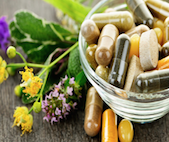
Botanical dietary supplements, sometimes called herbals or herbal dietary supplements, are products made from plants, plant parts, or plant extracts. They are meant to be consumed and contain one or more ingredients meant to supplement the diet. One recent nationwide government survey found that natural products, including dietary supplements, are used by approximately 18% of adults.
Botanical dietary supplements are used in both traditional and complementary medicine, and take many forms, including:
- Tablets
- Capsules
- Softgels
- Gelcaps
- Liquids
- Powders
Echinacea, green tea extract, garlic, and evening primrose oil are common examples of botanical dietary supplements used for health.
If a manufacturer wants to distribute a supplement containing a new dietary ingredient, they first must notify the U.S. Food and Drug Administration (FDA) before it can be sold. But notifying the FDA doesn't mean the FDA deems the ingredients or supplement as safe. The FDA is only responsible for taking action against products found to be harmful after they have started selling in the market.
NTP has received multiple nominations from the public and other federal agencies to study various botanical dietary supplements. This research is not concerned with the benefits of the supplement. Instead, NTP studies are designed to identify any potential harm from short and long-term exposure to these substances.
NTP Studies & Findings
NTP is conducting multiple studies to identify the potential harm of short and long-term exposure to botanical dietary supplements. These studies may provide toxicology data and help in determining the safety or risk of certain supplements. This data can be used by:
- U.S. Food and Drug Administration
- National Institutes of Health
- Public
- Health care providers
- Foreign Governments
- Other stakeholders
Below are NTP's ongoing and completed studies, each with a link to the testing status page, any recent updates, and any available reports.
| Botanical Dietary Supplement | Commonly Used For | Testing Status |
|---|---|---|
| Black Cohosh | Menstrual and menopausal symptoms | Ongoing |
| Echinacea Purpurea | Common cold and other infections | Ongoing |
| Garcinia Cambogia | Appetite suppression and weight loss | Ongoing |
| Valerian Root | Insomnia and other sleep disorders | Ongoing |
| Botanical Dietary Supplement | Commonly Used For | Testing Status |
|---|---|---|
| Aloe Vera | Constipation and gastrointestinal disorders | |
| Bitter Orange | Heartburn, congestion, weight loss | Completed |
| Black Cohosh | Menstrual and menopausal symptoms | |
| Ephedra | Weight loss, energy, performance | Completed |
| Ginkgo Biloba | Brain function and memory | |
| Ginseng | General well-being, improved physical stamina, and concentration | |
| Goldenseal | Skin disorders, ulcers, and fevers | |
| Green Tea Extract | Mental alertness, digestive symptoms, headaches, and weight loss | |
| Gum Guggul | Lowering cholesterol, acne, and weight loss | |
| Kava Kava | Anxiety | |
| Milk Thistle | Liver cirrhosis, chronic hepatitis, and gall bladder disorders, in addition to other ailments | |
| Senna | Constipation, irritable bowel syndrome, hemorrhoids, and weight loss | |
| Usnea Lichen | Weight loss | |
| Vinpocetine | Memory enhancement |
|
Informational Resources
Fact Sheets and FAQs
- NTP Botanical Dietary Supplements Program
Updated January 2024 - NIEHS Health Topic: Aloe Vera
Updated March 2026
Meetings
- Workshop: Addressing Challenges in the Assessment of Botanical Dietary Supplement Safety, Bethesda, MD, April 26-27, 2016
- NTP Board of Scientific Counselors Meeting, Research Triangle Park, NC, June 15, 2016
Other Resources
Publications
- Catlin, N.R., Collins, B.J., Auerbach, S.S., Ferguson, S.S., Harnly, J.M., Gennings, C., Waidyanatha, S., Rice, G.E., Smith-Roe, S.L., Witt, K.L., Rider C.V. How similar is similar enough? A sufficient similarity case study with ginkgo biloba extract. (2018). Food Chem. Toxicol. 118:328-339; https://doi.org/10.1016/j.fct.2018.05.013
- Collins BJ, Kerns SP, Aillon K Mueller G, Rider CV, DeRose EF, London RE, Harnly JM, Waidyanatha S. Comparison of phytochemical composition of ginkgo biloba extracts using a combination of non-targeted and targeted analytical approaches. Anal Bioanal Chem 412, 6789–6809 (2020); https://doi.org/10.1007/s00216-020-02839-7
- Hubbard, T.D., Hsieh, J.H., Rider, C.V., Sipes, N.S., Sedykh, A., Collins, B.J., Auerbach, S.S., Xia, M., Huang, R., Walker, N.J., DeVito, M.J. (2019). Using Tox21 high-throughput screening assays for the evaluation of botanical and dietary supplements. Appl. In Vitro Toxicol. 5(1):10-25; https://doi.org/10.1089/aivt.2018.0020
- Rider, C.V., Walker, N.J., Waidyanatha, S. Getting to the root of the matter: challenges and recommendations for assessing the safety of botanical dietary supplements. (2018). Clin. Pharmacol. Ther. 104(3): 429-431; https://doi.org/10.1002/cpt.1088
- Roberts, G.K., Gardner, D., Foster, P.M., Howard, P.C., Lui, E., Walker, L., van Breemen, R.B., Auerbach, S.S., Rider, C. Finding the bad actor: challenges in identifying toxic constituents in botanical dietary supplements. (2019). Food Chem. Toxicol. 124: 431-438; https://doi.org/10.1016/j.fct.2018.12.026
- Ryan, K.R., Huang, M.C., Ferguson, S.S., Waidyanatha, S., Ramaiahgari, S., Rice, J.R., Dunlap, P.E., Auerbach, S.S., Mutlu, E., Cristy, T., Peirfelice, J., DeVito, M.J., Smith-Roe, S.L., Rider, C.V. (2019). Evaluating sufficient similarity of botanical dietary supplements: combining chemical and in vitro biological data. Toxicol. Sci. 172(2): 316-329; https://doi.org/10.1093/toxsci/kfz189
- Shipkowski, K.A., Betz, J.M., Birnbaum, L.S., Bucher, J.R., Coates, P.M., Hopp, D.C., MacKay, D., Oketch-Rabah H., Walker, N.J., Welch, C., Rider, C.V. (2018). Naturally complex: perspectives and challenges associated with botanical dietary supplement safety assessment. Food Chem. Toxicol. 118: 963-971; https://doi.org/10.1016/j.fct.2018.04.007
- Waidyanatha, S., Mutlu, E., Gibbs S., Stiffler, B., Andre, J., Burback, B., Rider, C.V. (2019). Systemic exposure to ginkgo biloba extract in male F344/NCrl rats: relevance to humans. Food Chem. Toxicol. 131; https://doi.org/10.1016/j.fct.2019.110586
- Waidyanatha, S., Pierfelice, J., Cristy, T., Mutlu, E., Burback, B., Rider, C.V., Ryan, K. (2020). A strategy for test article selection and phytochemical characterization of echinacea purpurea extract for safety testing. Food Chem. Toxicol. 137; https://doi.org/10.1016/j.fct.2020.111125
- Waidyanatha, S., Ryan, K., Roe, A.L., Jia, W., Paine, M.F., Ferguson, S., Gurley, B.J., Welch, K., Chow, M.S.S., Devito, M., Rider, C. Follow that botanical: challenges and recommendations for assessing absorption, distribution, metabolism and excretion of botanical dietary supplements. (2019). 121: 194-202; https://doi.org/10.1016/j.fct.2018.08.062
Stay Informed & Contact Us

Stay Informed
Subscribe to receive email to stay informed about botanical dietary supplements research and other NTP information.
Contact Us
For questions or additional information, email us or use our contact form.